

Snow doesn’t stop stormwater pollution. It just stores it for later.
All winter, cigarette butts, wrappers, grit and road sediment build up in the snowbanks along curbs and parking lots. When the thaw comes, it all lets go at once and heads for the nearest catch basin. For a lot of Canadian municipalities, spring melt brings one of the heaviest litter loads of the year.
If a LittaTrap™ is already in the catch basin when that happens, it catches that load. If it’s still sitting on next year’s capital works list, it doesn’t. That’s the main reason to install this fall.
A decade of Canadian winters
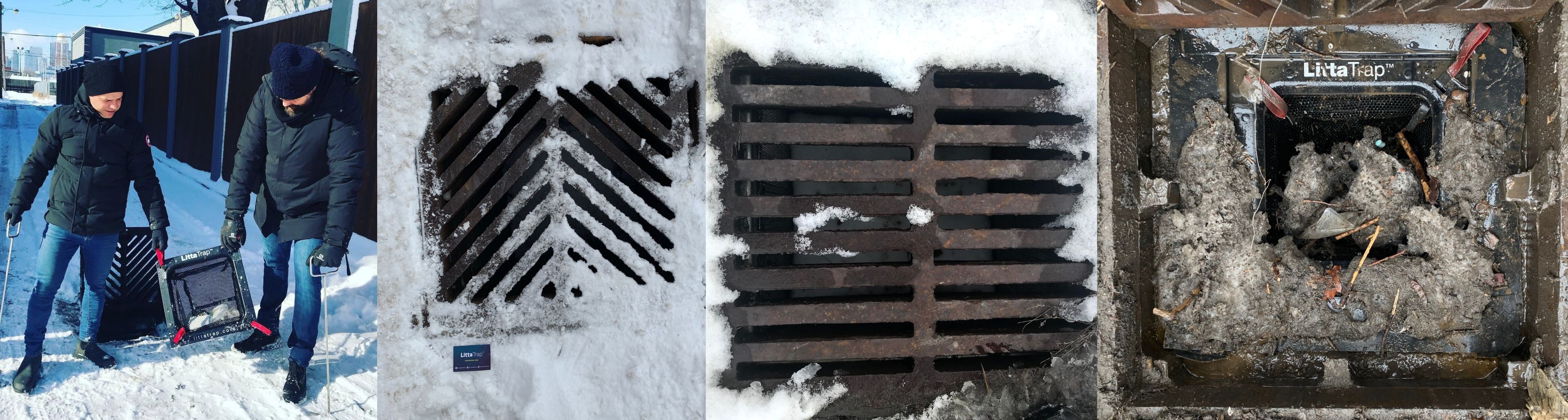
We often get asked whether LittaTrap™ holds up in sub-zero conditions. It does. The first Canadian units went in during 2016, and they’ve been working through winters ever since, including in regions where temperatures drop to -40°C.
The unit is made mostly from polyethylene, nylon, polyester and PVC. None of these rust, and all of them handle cold well, which matters for something that spends months in a frozen catch basin.
We’ve seen material in the basket freeze solid at Canadian sites during long cold spells. In a typical roadside catch basin, though, very little water moves while it’s below zero, so the unit isn’t under much load. We haven’t seen any evidence that freezing on its own shortens a LittaTrap’s life.
Sites with standing water or steady flow through winter are different. We’d want to look at those individually before recommending an install.
De-icing salt is hard on anything metal in a catch basin. LittaTrap™ is polymer-based, so salt corrosion isn’t the concern it is for metal components. That makes it a good fit for urban streets, highways, parking lots and municipal catch basins that see heavy salting.
Most stormwater upgrades get scheduled for spring and summer. Installing before winter has some clear advantages:
LittaTrap™ has been capturing litter in Canadian catch basins since 2016.
If you’d like traps in place before next spring’s melt, contact EnviroPod™ to talk through your sites.

